



Security in a market that faces growing challenges
Cybersecurity in the food industry
The food and beverage industry is relying on digitization to prepare for the future. Consistent protection against cyber threats should be planned for from the very beginning.
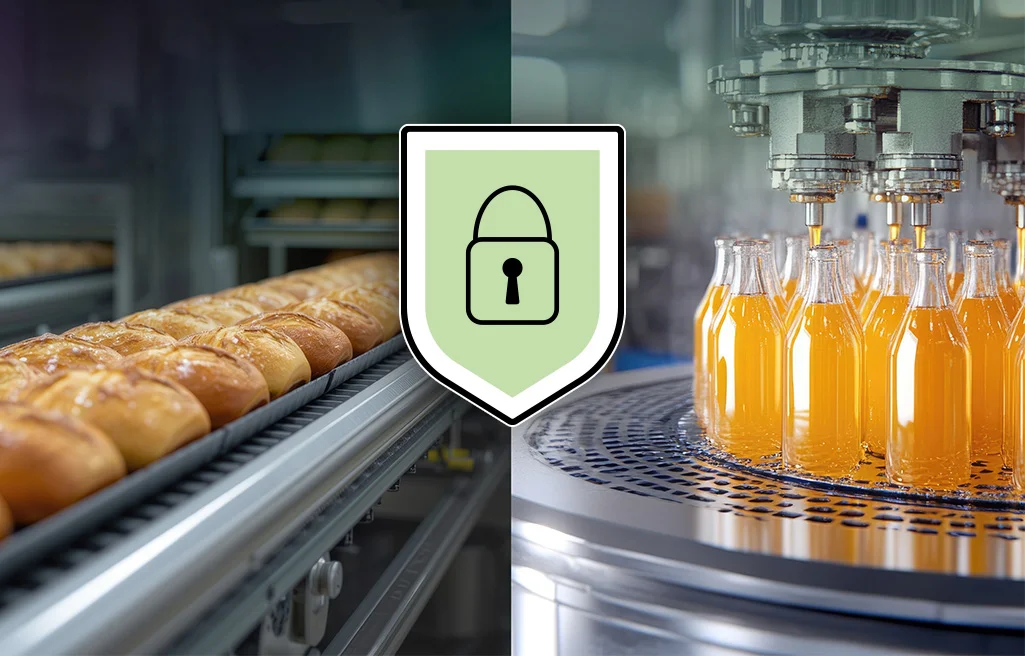
The world's population is growing: according to a United Nations forecast, around 9.7 billion people will be living on Earth by 2050. This development is also increasing the demand for safe, high-quality food. This opens up new opportunities for the food industry, but at the same time increases the requirements along the entire value chain.
Manufacturers are facing increasingly stringent food safety and quality requirements. Safety deficiencies can not only have consequences for consumers, but also have economic repercussions, such as product recalls or production downtime. In addition, the food industry is considered critical infrastructure. This means that it is also subject to strict information security requirements.
Furthermore, efficient processes and high plant availability are crucial in order to remain competitive in an increasingly global market.
Digitization in the food industry
Digitization is seen as a way to improve food safety while increasing efficiency. The networking of production and the supply chain form the basis for data collection. Evaluating and analyzing this data can reveal potential for optimization in terms of both safety and cost-effectiveness.
At the same time, manufacturers can perform machine maintenance via digital remote access to improve plant availability. This helps to avoid bottlenecks in production. The use of digital track and trace technologies enables optimized traceability of products from the producer to the consumer. For foods that require refrigeration, such a process is essential today.
Networking also offers food producers the opportunity to document compliance with regulations and thus create transparency.
Why cybersecurity is crucial in the food industry
As helpful as networking may be in improving food safety, it also creates new risks: as soon as a machine or system is connected to the internet, it becomes a potential gateway for malware.
Cybercrime is on the rise worldwide and does not stop at food. In May 2025, a massive digital attack on a German dairy center attracted media attention. Just one month earlier, a brewery had been hit by a ransomware attack. Criminals had managed to encrypt and steal data in order to extort ransom money.
Regulatory requirements under NIS2
Due to the high threat level, companies operating critical infrastructure are obliged to ensure security: The Critical Infrastructures umbrella law prescribes extensive protective measures and primarily affects large institutions. The European Union wants to create a comparable level of protection within the community of states and has therefore introduced the NIS2 Directive, which also addresses smaller businesses, namely all “important facilities” in critical sectors as soon as they have more than 50 employees or 10 million in turnover.
How to secure networked production environments
The good news is that there are solutions that can deliver both efficiency and security. The Endian Secure Digital Platform offers the ability to network OT and IT systems in order to collect data and perform remote maintenance. At the same time, networked devices are protected against cyberattacks with a multi-level security concept.
Companies in the food industry can reconcile cybersecurity and efficiency by:

Segmenting networks
Network segmentation is the basis for cybersecurity in increasingly networked environments. It ensures that malware cannot spread from one system to the next by dividing the networks into smaller segments. This division of the networks is implemented with the help of security gateways.
Endian 4i Edge Gateways are equipped with several finely tuned cybersecurity tools and enable bilateral data connection. This allows production data to be securely collected and evaluated to improve plant availability.
Implement secure remote access
Since the data connection works in both directions, remote access is also possible. If one of the networked sensors registers an error that could potentially compromise food safety, the system can also be checked remotely.
Communication is encrypted and secured via VPN. Maintenance work, error analyses, and software updates can be carried out efficiently without jeopardizing the production environment.
Use role-based access rights
The management of access rights also plays a decisive role in secure remote access. The Endian Secure Digital Platform enables granular, role-based assignment of access rights. Users, service providers, or service technicians are only granted access to the systems and functions they need for their respective tasks. This access can also be limited in time and fully logged. This not only reduces the risk of operating errors or misuse, but also supports compliance with regulatory requirements and audit specifications.
Apply zero trust
This also provides a basis for implementing the zero trust principle, as required by NIS2, for example. The zero trust principle describes a security model in which no access is trusted, even if it takes place within a network. Devices, users, and applications must clearly identify themselves before a connection is allowed. The Endian Secure Digital Platform thus meets the central requirements of modern zero trust architectures and creates a robust foundation for secure networked production environments.
Use third-party applications via Docker containers
Machine data is evaluated either using third-party software or applications developed in-house. Docker containers allow such solutions to be quickly transferred from one gateway to the next. This process can also be automated to shorten rollout times. Docker containers also contribute to IT security because they function completely independently of each other. If one container fails, all the others continue to work.
Ensuring digital sovereignty
Digital sovereignty means that companies can retain control over their processes, data, and infrastructure at all times. Due to the tense geopolitical situation, combined with the unreliability of some players, this issue is more important than ever. Companies need a holistic concept to be able to act independently and autonomously at all times. The Endian Secure Digital Platform was developed according to the principle of security by design, so that security is incorporated at every stage of development. The platform is also available as an on-premises solution. This gives companies the choice of where they want to host the solution.
Conclusion
Digital networking, data transparency, and remote access do not have to be a security risk for companies in the food and beverage industry. With the Endian Secure Digital Platform, modern production concepts can be implemented without compromising cybersecurity or compliance.