



Secure remote access
The backbone of decentralized energy supply
The energy transition is decentralizing power supply, replacing large plants with distributed solar, wind and storage systems. This creates new challenges for control and maintenance, making secure remote access essential. This article explains how to achieve it.
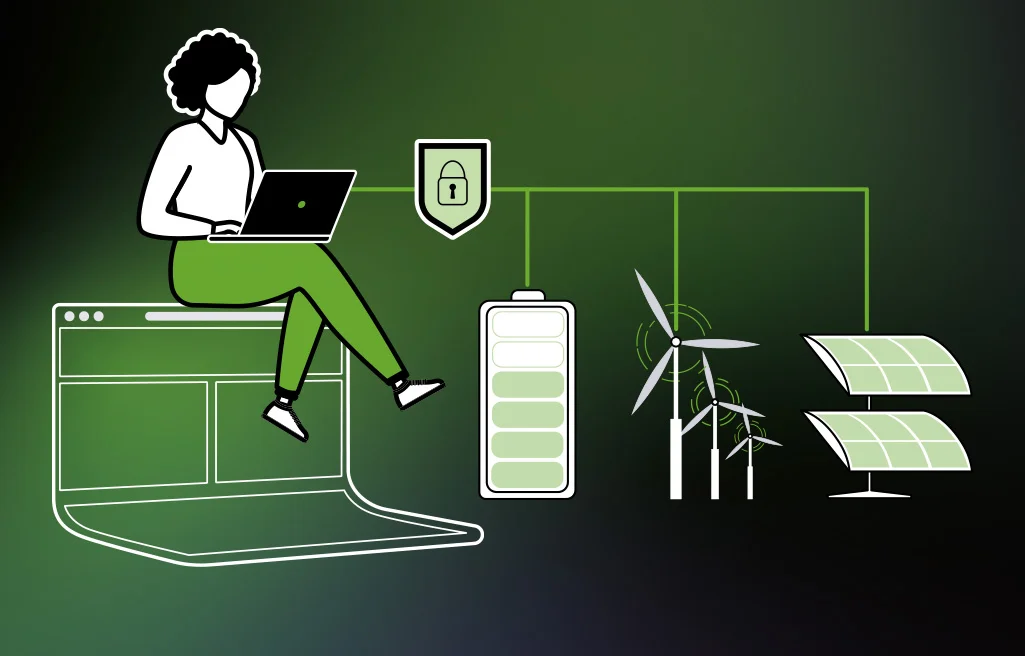
Whether solar panels on residential buildings, onshore and offshore wind farms, battery storage facilities, or substations—decentralized energy systems can be found almost everywhere today, and their numbers are constantly growing. In the first half of 2025, 57.8 percent of the electricity produced in Germany already came from renewable energy sources (source: Federal Statistical Office), with photovoltaic power generation in particular seeing strong growth. Secure remote access connects these distributed systems and enables their smooth operation.
Grid stability and efficiency
One challenge in a decentralized energy landscape is maintaining grid stability. To keep the power grid in balance, energy feed-in and consumption must be constantly coordinated. Remote access provides the digital connection between the plants and the grid operators. It continuously transmits the production and consumption data required for precise control. If fluctuations occur in the grid, operators can quickly ramp up or ramp down the plants via remote access. Remote access thus functions not only as a data channel, but also as a control instrument that ensures the stability of the system.
Stable remote access is also essential for the efficient operation of thousands of small systems. Many tasks, such as maintenance, parameterization, and software updates, can be performed remotely. In the event of malfunctions, operators can respond immediately without having to send personnel to the site first. Remote access thus reduces downtime, travel, and personnel costs, while also making operations more flexible and resilient.
One system, multiple access points
To perform these numerous tasks, different parties need access to the same system. This can be illustrated using the example of a wind turbine: for operators, the focus is on electricity production. Remote access allows them to continuously monitor how much energy is being fed into the grid so that they can reduce output or temporarily disconnect the system from the grid in the event of imminent grid overload.
At the same time, maintenance personnel monitor technical operating data such as the temperature of the generators or vibrations in the tower. This allows signs of abrasion to be detected at an early stage and maintenance measures to be planned before major damage occurs. While technicians need to be on site for certain repairs, they can perform other tasks remotely, such as updating the control software.
Remote access: Safety first
When multiple parties need to access the same system and have different tasks to perform, it is important to assign rights and permissions on a granular basis. Each party should only be able to view the data and perform the actions that are relevant to their specific purpose. This principle of minimal access rights reduces potential vulnerabilities and ensures the safe operation of the system.
Centralized access management helps to maintain an overview. A dashboard can be used to visualize who is currently connected. All rights and permissions should be able to be changed or deleted in real time to prevent unauthorized access. This can be important, for example, when responsibilities change or an employee leaves the department or company.
For certain interventions in the system, it may also be useful to document the remote maintenance session. This makes it clear who carried out which measures and when. This facilitates troubleshooting, increases transparency, and helps to clarify liability issues in the event of an incident.
Protect data transmission
In addition to clearly assigning access rights, protecting the data streams themselves is also crucial. The production and control data transmitted between plants and control centers contains sensitive information about the condition and performance of the infrastructure. If this data falls into the wrong hands, it could be manipulated or misused for targeted attacks.
An encrypted connection via a virtual private network (VPN) helps to prevent such a scenario. It ensures that communication between the production plant and the control center remains protected and cannot be intercepted or altered by third parties. This ensures that control commands arrive reliably and operating data remains protected.
Two-factor authentication
Another sensitive issue is access to the remote maintenance solution. Traditional username-password combinations are no longer secure enough, as passwords can be easily decrypted or used multiple times. Two-factor authentication increases the level of security here. The login is supplemented by an additional feature, such as a one-time code on the smartphone. Even if attackers gain access to the login details, they will still lack the second factor required to log into the system. This means that only clearly identified individuals are granted access, and digital control over the systems is just as secure as physical keys.
Conclusion
Decentralized energy structures require remote access to ensure smooth operation and grid stability. Given its crucial role, remote access must be protected against risks from cyberspace. Endian offers a secure remote access solution that has proven itself in a wide variety of scenarios over many years.